
Thursday, November 19, 2015

Monday, November 2, 2015
Friday, October 9, 2015
Friday, May 22, 2015

Sunday, April 5, 2015
Highway Bridge 30
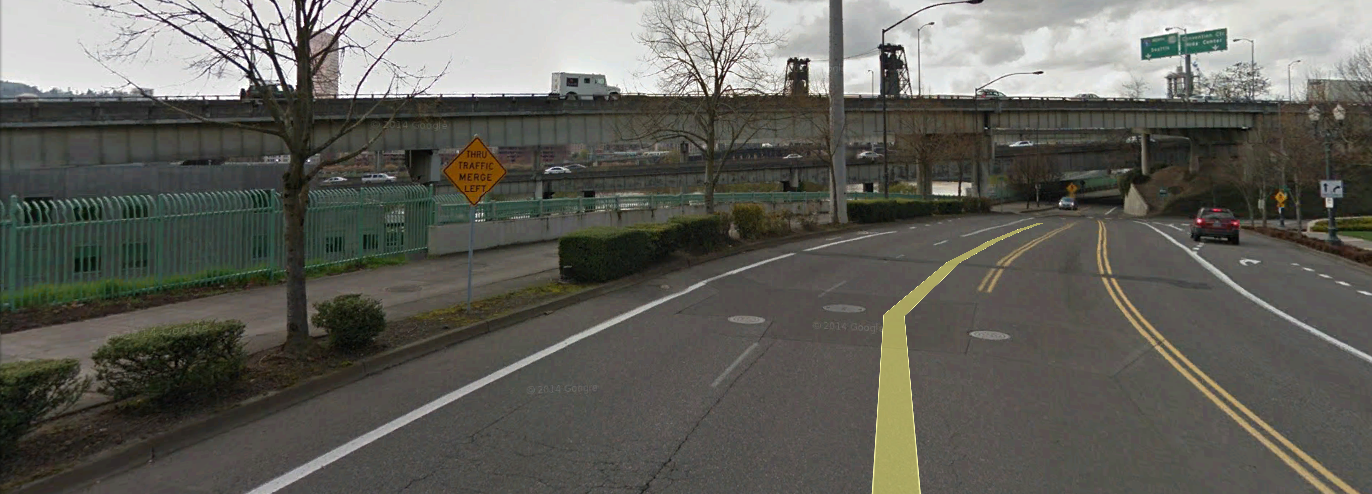


The location of this span is near the Oregon Convention
center. The span’s function is a highway
to carry traffic towards Interstate 5 towards North to Seattle. It is highway 30.
The superstructure is steel girder with varying depth to span
ratios. The smallest span crosses a two
lane road and pedestrian sidewalk. It is
approximately 30’. The Steel girder for
this section of the span is smaller than the previous span. Thus it has a smaller depth girder. The smaller girder sits on the bent cap next to
the larger depth girder. There are two
different thicknesses for the bent cap.
The bent cap rises to meet the smaller girder to create a level
transition.
The superstructure depth to span ratio is bulky. The proportion is not ideal. The span of 30’ has nearly the same girder
depth as the previous girder which seems to span 90 or more feet. This might be because the much smaller girder
would require another bent cap. Further
study is needed to find the right depth to span the 30’. It does however match the next girder’s
depth. Perhaps the designer decided to
match at least one girder to create a smoother transition and to make the bent
cap seat the same for the right bent cap.
One option is to make the girder the same size as the previous
girder. However, the need for clearance
might have motivated the designer to narrow the depth of the girder as much as
can be done. Most like the depth at this
section was to match the next girder and to make ease of construction and
detailing a priority instead of structurally expressing the span to depth ratio
of the girder. The designer could have
celebrated this section of span as a gateway to the city with a smaller girder
and creating haunches to express the gateway towards the city. As is, the column land haphazardly on the
pedestrian sidewalk and the other one extending to another level below.
The bent cap is connected to circular columns. The bent cap cantilevers beyond the circular
column on both ends. The cantilever part
of the bent cap could have been drop to express the structural
proportions. The deck protrudes beyond
the steel girders creating shadows to differentiate the different levels. The effect is to reduce the mass of the
structure and expresses each part of the bridge structure. Underneath the girder there appears to be
diagonal cross bracings which look to be approximately the same depth as the
girder but flush with the bottom of the girder.
The railing is concrete which makes the bridge look bulky. An option is to use metal lattice
railing. But the thin concrete railing
is much smaller than the steel girder that one hardly notices it. Perhaps the concrete railing provides more of
a visual stability for the automobiles which could crash into the railing and
fall onto the highway below it. Some of
the support is shew because there is no room for the column to land due to
serval lanes coming together at various angles which intersect.
Overall the design is not well thought out and the
transitions clumsy. As is typical of
most highway bridges, the way it is designed, priority is given to practicality
and utilitarianism. There were
opportunities to express the structural proportions in the depth to span ratio
and create a unique gate way for the traffic heading toward the city
center.
Friday, April 3, 2015
Building Better Bridges
In ‘Building Better
Bridges’ Paul Giroux wanted to highlight some of the unique challenges and
issues we all face in the signature bridge market.
Society has love affair
with landmark bridge: The challenge of
any design problem is to find the right balance of aesthetics (form) and
performance (function). There are a lot
of frustration with the politics, selection process, time, inaccurate budget
estimates, constructability and durability.
Paul used the Minnesota Bridge as an example of unclear bidding process. Even with these frustrations, society want
more then just function, they want form and project their fantasies onto the
bridge hoping that a bridge will beautify their surroundings. There is a demand for major bridges to be
more than just spans. Bridge also wants
to be monuments. Paul used the San
Francisco Oakland Bay Bridge (SFOBB) as an example of the politician’s desire
for a landmark. They didn’t want a
“freeway on stilts”. The Dallas City
Council hops to transform and improve the Dallas landscape with their new
bridge across the Trinity River designed by Spanish architect Santiago
Calatrava. The politicians in western
New York want to emulate the success of the Golden Gate as a new gateway, a defining
moment of entry.
Form vs. Function. Paul spoke about form follows function idea
in design. If we put function as a
priority then form follows its function.
Conversely, when a bridge is designed with aesthetics as a priority, its
function follows its form. There is a
spectrum between form and function. A
successful bridge would be a balance of the two. A bridge by function could be defined as a
structure to span a gap and to provide passage.
A bridge by form could be defined as work of art, to span time and
provide an icon for the dreams and vision of a society. Between those two poles a tug of war goes on
as we endeavor to make our bridges all things to all people.
Historically, Function
has dominated much of bridge design. The
new Signature bridges are replacing the old ones. In the process of selecting a bridge, the
economic involve is difficult to sort through because the design is still in a
schematic phase and cost has not been finalized. The modern post-tensioned technology and
improved concrete mixes have allowed reinforced concrete bridge to be push ever
higher levels of performance, longer spans and increased durability. We are replacing the broken bridges with new
signature bridges. Paul is concerned
that our selection process places too much emphasis on aesthetic
considerations. This needs to
change. He lists the following
categories of changes:
·
Depoliticize the Process
·
Training and Education
·
Learning from our Past
·
Realistic Conductible Details
·
Inform bridge selection: Form and Function
·
Maintain what we build.
A bridge stretched across a river, Heidegger argues, provides such a sense of space. Out of
numerous possibilities along the river, the construction of a bridge was the
site in which a place was constituted. For Heidegger the
bridge in not just a functional object, nor is it a dual signifier of
referential object and symbolic meaning. For Heidegger, a
bridge is a manifestation of the fourfold which is at the base of all dwelling.
A bridge collects and unites all aspects of the fourfold, earth, sky, mortals
and divinities into a "thing". Such things are distinguishes from one
another by the manner in which the manifest the unity of the fourfold. A
bridge, in other words, allows for dwelling on account of its predetermined
unification of the fourfold.
Monday, March 23, 2015
Materials and Dematerialization

This book is a second book about material that piqued my interest. The first book is 'Stuff Matters'. Vaclav Smil's book seems more serious compare to 'Stuff Matters' written by a scientist and engineer. The Strength of material class got me interested in looking at material. In our Structural Systems class we had a speaker from the Architecture department gave a talk about material in construction. He compared parking garages and the concrete material versus steel. He looked at which material is more sustainable then the other one. Concrete has some problems with it. A fact Bill alerted me to is that China used more cement in the last three years than the U.S. used in the entire 20th century.
Before other
building material , I was interested in
paper as a material for journal writing, structural models and origami. I had not thought about structural system or
selection nor the material production of concrete and steel. We were taught to design but I don't recall
having a deeper understanding of material selection or production cost and the
environment.
Bill
Gate's Review has some interesting thoughts on paper because he is pushing
towards a paperless office. As a
mortgage processor I know that we have decrease the amount of paper file we
keep. Most of the documents can now be
electronically signed. Most of our
papers are handed in to an electronic drop box in the form of PDFs. Smil suggests that paper will still be with
us for a very long time.
Smil's idea of
dematerialization states that as a given product becomes more efficient to
produce, prices go down and consumption goes up. An example, someone makes a cell phone with less metal, which
makes them cheaper, which makes them more widespread. "Less," Smil states, "has thus been an enabling
agent of more."
There are some great
infographics on Mr. Gate's review. Check
it out.
Subscribe to:
Posts (Atom)